Bonebenders vs Bonedrillers 1-0: Speed Beats Complexity

In brief — Bone expansion with simultaneous implant placement cuts treatment time in half compared to traditional GBR, reduces postoperative swelling and pain, improves profit margins, and creates the word-of-mouth advantage that defines a successful practice. Speed isn’t a detail: it’s your competitive edge in the market.
Bonebenders vs Bonedrillers: Why You’re Losing Patients (And Don’t Even Know It)
Have you ever added up how many hours of your professional life you’ve spent waiting for xenograft bone to integrate?
How many times have you told a patient “let’s meet again in six months,” knowing that in the meantime they might go looking for something faster?
How many membranes or plates have you positioned thinking “surely there’s a simpler way”?
There is. And the colleagues who use it are building a competitive advantage that you, with every passing day, find harder and harder to close.
The Truth They Hide From You at Congresses
While you plan two-stage GBR with bovine bone and membranes, there’s a colleague in your own city solving the same case in a single session. Expand, place the implant, close.
Actually, no.
They leave it open, thanks to second-intention healing.
While you tell the patient “see you in eight months,” they send that patient home with the implant already placed and stable — sometimes even under immediate loading.
While you recommend ice and anti-inflammatories for the expected swelling, their patient comes back the next day with no appreciable edema.
And guess who that patient will recommend to their friends?
It’s not luck. It’s not a special case. It’s a replicable system you can learn. But first you have to accept an uncomfortable truth: much of what you were taught about bone regeneration serves to sell biomaterials more than to treat patients.

And yet it isn’t purely commercial: it’s ignorance, or to be kind, “non-knowledge.”
Pity I’m not that kind.
As the Poet said: “You were not made to live like brutes, but to follow virtue and knowledge.”
Poor Dante.
What would he think if he saw today’s communities of dentists who worship flat-earth theories and other nonsense?
He surely never dreamed of ending up as a citation in a blog for dentists.
Who knows which circle of hell he’d assign us to.
Straight down, no doubt 🔻
But the Bonedrillers, in my book, go deeper… 😎
Let’s Get the Little Elephant Out of the Room

It’s true: not every case is suitable for osteo-mucosal expansion.
But today the cases that would go to GBR and could instead be solved by expansion are far more than they used to be.
That’s why ignorance costs — and you can no longer afford to prop it up on your own.
The Numbers That Count
Let’s do the math no sponsored speaker will ever do during a course.
Today you run a traditional two-stage GBR. Let’s count:
Total operating time: 180-240 minutes across the first surgery, the second surgery and managing any complications. Your time is worth, say, X per hour as a qualified operator. That’s 3X-4X of time.
Materials: xenograft bone 2X-3X, membrane 2X-3X, fixation screws X, implant X. Total materials: 6X-8X.
Appointments: at least six. First visit, CBCT, first surgery, check-up, suture removal, second surgery, check-up, suture removal. Every appointment has a cost in chair time, assistant, sterilization.
Clinical risk: membrane exposure 10-25%, need for re-intervention 5-15%, regenerative failure 3-8%.
Total patient time: 10-12 months from start to definitive prosthesis.
Now compare it with simultaneous expansion.
Total operating time: 60-90 minutes. Single session. That’s X-1.5X of operator time.
Materials: implant X, any specific instruments amortized, minimal biomaterial if needed 0.5X. Total: X-1.5X.
Appointments: three or four. First visit, CBCT, single surgery, check-up, suture removal, prosthetics.
Clinical risk: manageable fracture 0-5%, need to convert to GBR <1%, predictable result in 97-99% of cases. That’s not my impression as someone who sells courses: it’s what the meta-analyses say, and you’ll find them below, with names, journals and numbers.
Total patient time: 4-5 months from start to definitive prosthesis.
Margin difference for you: 2X-3X versus 9X-12X: roughly 300-600 euros more per single implant. Multiply it by your 30-50-100-200 regenerative cases a year. That’s 9,000-30,000-60,000-120,000 euros you’re leaving on the table. Every year.
What the Literature Actually Says
Up to here you might think I’m the usual snake-oil salesman. Fair enough. So let’s look at the real numbers, the published ones.
Al Haydar and colleagues (International Journal of Oral & Maxillofacial Implants, 2023) pooled 35 studies and 4,446 implants placed in expanded ridges: 98.17% survival, a mean horizontal gain of 3 mm. The figure that should make you stop is another one: adding or not adding graft bone made no difference to the result — 2.97 mm with, 3.06 mm without. Expansion alone works. It’s graftless regeneration taken to its logical extreme.
Azadi and colleagues (Oral and Maxillofacial Surgery, 2025) went deeper on expansion with simultaneous implant placement: 100% survival, 0% complications. They open the review by calling expansion “one of the quickest, simplest and most reliable methods” of ridge augmentation. I didn’t write that. They did.
And GBR? I’m not burying it. Vorovenci and colleagues (Biomedical Reports, 2024) compared osseodensification, GBR and ridge-split head to head: GBR gains a touch more horizontally (4.04 mm versus the 3.66 mm of ridge-split), but we’re talking fractions of a millimeter, not different worlds. To get those extra tenths, GBR demands two stages, membranes, waiting. For most thin ridges that margin doesn’t justify the price. It’s the same reasoning behind the meta-analysis on horizontal bone defects.
Then there’s the swelling chapter, the one patients actually remember. Alotaibi and colleagues (Clinical Oral Implants Research, 2025), in a network meta-analysis on vertical augmentation, found that periosteum-preserving techniques lose less bone and cause fewer healing complications; raising wide flaps, by contrast, costs you volume at re-entry. That’s the biological explanation for why my patients barely swell: less flap, more vascularization, less trouble.
And I Haven’t Even Mentioned the Value of Word of Mouth
The advantage you can’t measure in euros.

Every patient who leaves your practice without major swelling and without much discomfort in the following days is a patient who will speak well of you.
Every professional who didn’t have to take days off work will recommend you to colleagues, friends and relatives. Every patient who solved it in four months instead of twelve becomes a promoter of your practice.
This doesn’t show up in the immediate balance of your costs. But it builds your reputation month after month.
While your competitors who still do GBR on everything are more likely to have to manage swelling and postoperative pain, you accumulate five-star reviews and positive word of mouth.
In 2025, with Google reviews, Trustpilot and social media, that’s worth gold. A satisfied patient talks to ten people.
An unsatisfied patient talks to a hundred.
And the dissatisfaction might even be unfair! Edema is a normal reaction to a surgical procedure. It’s irrelevant to the outcome.
But if you can avoid it or reduce it, why wouldn’t you?
Sure, it happens with expansion too, sometimes. But far more rarely.
Which Side Do You Want to Be On?
Simultaneity isn’t a technical detail. It’s your competitive advantage.
When you place the implant at the same time as the expansion, you’re doing something powerful from a marketing standpoint: you’re giving immediate certainty.
The patient leaves your practice knowing the implant is there. It’s not a promise. It’s not an “if all goes well.” It’s a done deal.
That completely changes the perception of value. The patient isn’t buying the hope of an implant in eight months. They’re buying an implant they already have in their mouth. The psychological difference is enormous.
And clinically? Expanded bone is vital bone. You don’t have to wait for bone substitutes to integrate. The implant osseointegrates in living, vascularized, active bone. The primary stability you get in expanded bone is not comparable to what you get in a site regenerated with biomaterials.
Your GBR colleagues have to hope. You know.
“But GBR can often be done with simultaneous implant placement.”
Yes. But you still have to wait for the graft to integrate.
Zero Swelling, Zero Pain: The Holy Grail of the Post-Op
Think about the last GBR you did. Think about the patient the next day. Swelling? Present. Bruising? Sometimes. Pain? Manageable but present. Need for ice, anti-inflammatories, rest? All present.
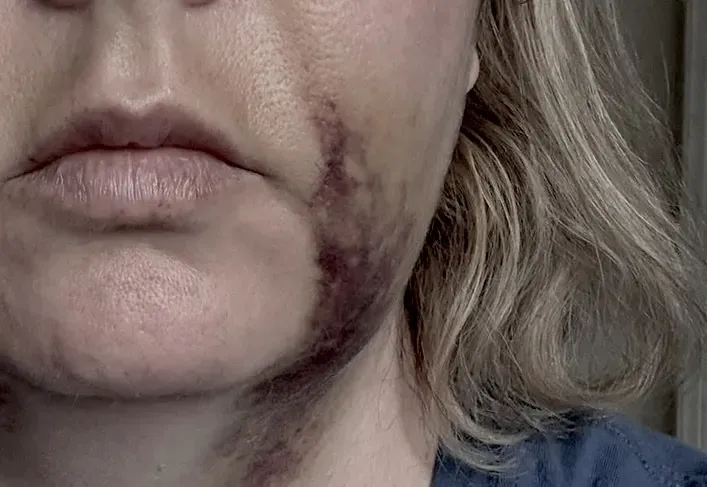
Of course, it’s all normal for a procedure like that. Absolutely true.
But why not avoid it, when you can?
Now think about my patients after expansion. Minimal or absent swelling. Pain? Most don’t even take a painkiller. They go back to work the next day as if nothing happened.
You must always plan an analgesic regimen proportional to the procedure, on top of antibiotic coverage. But in practice, patients more often than not don’t follow the prescription — because they have no symptoms.
It’s not magic. It’s physics and biology.
When you avoid raising wide flaps, you don’t create edema and you reduce the blood extravasation. When you don’t insert large volumes of foreign graft material, you don’t trigger massive cell-mediated responses. When you keep vascularization and periosteum, you favour rapid healing.
And that translates into a huge advantage: the patient talks about you as “that dentist who doesn’t make you swell.” Try competing with that positioning using only traditional GBR.
Speed as the “Killer Feature”
In business there’s a concept called “time to market.” How long it takes to bring a product from concept to market.
In regenerative implantology, your “time to market” is how long it takes to move the patient from “I’m missing teeth” to “I have fixed teeth.”
Two-stage GBR: 10-12 months. Expansion with simultaneous implant: 3-5 months.
You’re more than twice as fast. In a competitive market, that counts.
The patient who visits you and your GBR colleague receives two different proposals. You: “Four months and you’re done.” Him: “A year, if all goes well.”
At equal results, who will they choose? And above all, who will they recommend?
Speed isn’t just a clinical advantage. It’s a devastating marketing advantage.
Intellectual Honesty: Expansion Doesn’t Solve Everything
Severe vertical atrophy, hourglass-shaped bone, particularly dense structures: in these cases GBR can be superior or the only option.
But we’re talking about 20-30% of cases. Not 100%.
The problem isn’t that GBR exists. The problem is that it gets applied even where it isn’t needed. Out of habit. Out of perceived safety. Out of inertia.
And inertia, in a competitive market, is the fastest way to lose patients.
A Clinical Case to Shift Your Perspective
Picture a hypothetical case of C3 mandibular atrophy in the alveolar bone classification. The ridge has a width of just 3-4 mm, which many consider borderline.
Traditional approach: GBR, xenograft bone, membrane, wait 7-8 months, place implant, wait another 3-4 months. Total: a year.
Bonebending approach: expansion with diamond discs, simultaneous implant placement with primary stability in vital bone, closure. Total: 4 months. Operating time: 75 minutes. 3 appointments.
Same final result. Half the time. Half the appointments. Fewer materials. More margin.
And the patient? They speak well of you after two days instead of after two weeks.
That’s the competitive advantage.
The Questions You Must Ask Yourself in the Mirror
Are you doing GBR because it’s genuinely the best choice for that patient? Or because it’s your comfort zone?
Are you using biomaterials because they’re necessary? Or because it’s what you’ve always done?
Are you planning two stages because it’s indicated? Or because you never learned the alternatives?
If the answer to even one of these questions makes you uncomfortable, it’s time to change.
Because while you stay in your comfort zone, your competitors are building practices full of satisfied patients who recommend them to other patients.
The Investment That Pays Off
Training in the Bonebenders’ techniques takes time and the willingness to put yourself on the line again: new instruments and an initial learning curve.
But let’s do the real math.
What’s the cost of NOT trying this approach? Losing patients. Losing margin. Losing competitiveness.
The Truth That Hurts
As you read this article, a colleague in your city is finishing an expansion with simultaneous implant. The patient will walk out in half an hour with the implant in their mouth, zero swelling, minimal pain.
And tomorrow that patient will tell their office colleagues: “My dentist is a wizard, no pain, no swelling, put the implant in straight away.”
Three of those colleagues need implants. Guess who they’ll call?
You can keep doing GBR on everything. You can keep saying “this is how it’s always been done.” You can keep following the protocols the industry promotes.
Or you can wake up and realise the market is changing. That patients compare. That the competition doesn’t sleep.
And that every day you go without updating yourself is a day someone else takes your place.
What Do You Do Now?
You have three options. Three roads ahead.
First road: you ignore everything. You close this article thinking “it’s all exaggerated.” You go back to your routine. GBR, two stages, long waits, swollen patients. Comfort zone. In five years you’ll wonder why you have fewer and fewer new patients.
Second road: you start looking into it. You read the studies. You watch the cases. You ask questions. Maybe you discover I was right.
Or maybe you confirm your doubts and think “Ernesto is an idiot.” You’re free to think so. But at least decide with your own opinion, not someone else’s.
Third road: you train. You invest. You learn. You apply. You document. You improve. You become competitive. You build a practice full of happy patients who recommend you to other happy patients.
The choice is yours. But remember one thing: not choosing is still choosing. Choosing to fall behind.
Conclusion: The Advantage You Can Steal
The Bonebenders have an enormous competitive advantage. But it isn’t unassailable. It isn’t patented. It isn’t secret.
You can learn it. You can replicate it. You can bring it into your practice.
Does it take investment? Yes. Study? Yes. Practice? Yes.
But the return is higher than any other training you’ll do in the coming years.
Execution speed higher by 60-70%. Simultaneous implant placement in 90% of cases. Minimal patient impact. Swelling almost absent. Negligible pain. Total times halved. Higher margins. Positive word of mouth.
This is the daily reality of the Bonebenders in 2025.
You can keep fighting with 2010 weapons. Or you can update yourself and compete on equal terms.
But decide quickly. Because while you think, your competitors act.
And the market waits for no one.
Uncomfortable Questions (You Must Ask Yourself)
If the Bonebenders’ techniques are so superior, why weren’t they taught to me at university? For the same reason you were taught more GBR techniques than expansion techniques. University programs are often influenced by whoever teaches them. And it shouldn’t be that way. Professors should teach everything, without bias. The biomaterials industry funds chairs, research, scholarships. Follow the money and you always find the answers. Professors who teach these techniques exist, but they’re a minority. And they often don’t have the sponsors the others do. And then, at university, conspiracy theorists of every kind and faction sometimes turn up too: what are we even talking about?
References
- Al Haydar B, Kang P, Momen-Heravi F. Efficacy of Horizontal Alveolar Ridge Expansion Through the Alveolar Ridge Split Procedure: A Systematic Review and Meta-Analysis. Int J Oral Maxillofac Implants. 2023;38(6):1083-1096. doi:10.11607/jomi.9972 · PMID: 38085739
- Azadi A, Hazrati P, Tizno A, Rezaei F, Akbarzadeh Baghban A, Tabrizi R. Bone expansion as a horizontal alveolar ridge augmentation technique: a systematic review and meta-analysis. Oral Maxillofac Surg. 2025;29(1):32. doi:10.1007/s10006-025-01335-5 · PMID: 39808204
- Vorovenci A, Drafta S, Petre A. Horizontal ridge augmentation through ridge expansion via osseodensification, guided bone regeneration and ridge-split: systematic review and meta-analysis of clinical trials. Biomed Rep. 2024;21(4):139. doi:10.3892/br.2024.1827 · PMID: 39161939
- Alotaibi FF, Buti J, Rocchietta I, Mohamed Nazari NS, Almujaydil R, D’Aiuto F. Premature Bone Resorption in Vertical Ridge Augmentation: A Systematic Review and Network Meta-Analysis of Randomised Clinical Trials. Clin Oral Implants Res. 2025;36(7):787-801. doi:10.1111/clr.14435 · PMID: 40116110
References
- https://doi.org/10.3389/fbioe.2025.1630495
- https://doi.org/10.1007/s10006-025-01335-5
- https://doi.org/10.11607/jomi.9972
- https://doi.org/10.3892/br.2024.1827
- https://doi.org/10.1111/clr.14435
- https://pubmed.ncbi.nlm.nih.gov/38085739/
- https://pubmed.ncbi.nlm.nih.gov/39808204/
- https://pubmed.ncbi.nlm.nih.gov/39161939/
- https://pubmed.ncbi.nlm.nih.gov/40116110/
Go deeper
Espansione crestale (split crest) →Allargare la cresta senza trapianto — tecnica ERE e bonebending
Need a professional opinion?
Book an appointment at Dr. Bruschi's practice in Frosinone. First visit includes full diagnosis and personalised treatment plan.
Stai valutando un impianto dentale?
Ho scritto una guida in 8 capitoli che spiega tutto quello che un paziente dovrebbe sapere prima di sedersi in poltrona. Niente marketing — solo fatti, casi studio e una checklist per fare le domande giuste.
Scarica la guidaStay Updated
New articles on periodontology, implantology and oral surgery — delivered to your inbox.
Comments
Loading comments...
Leave a comment