Albucasis: the Cordoban Who Invented the Periodontal Curette
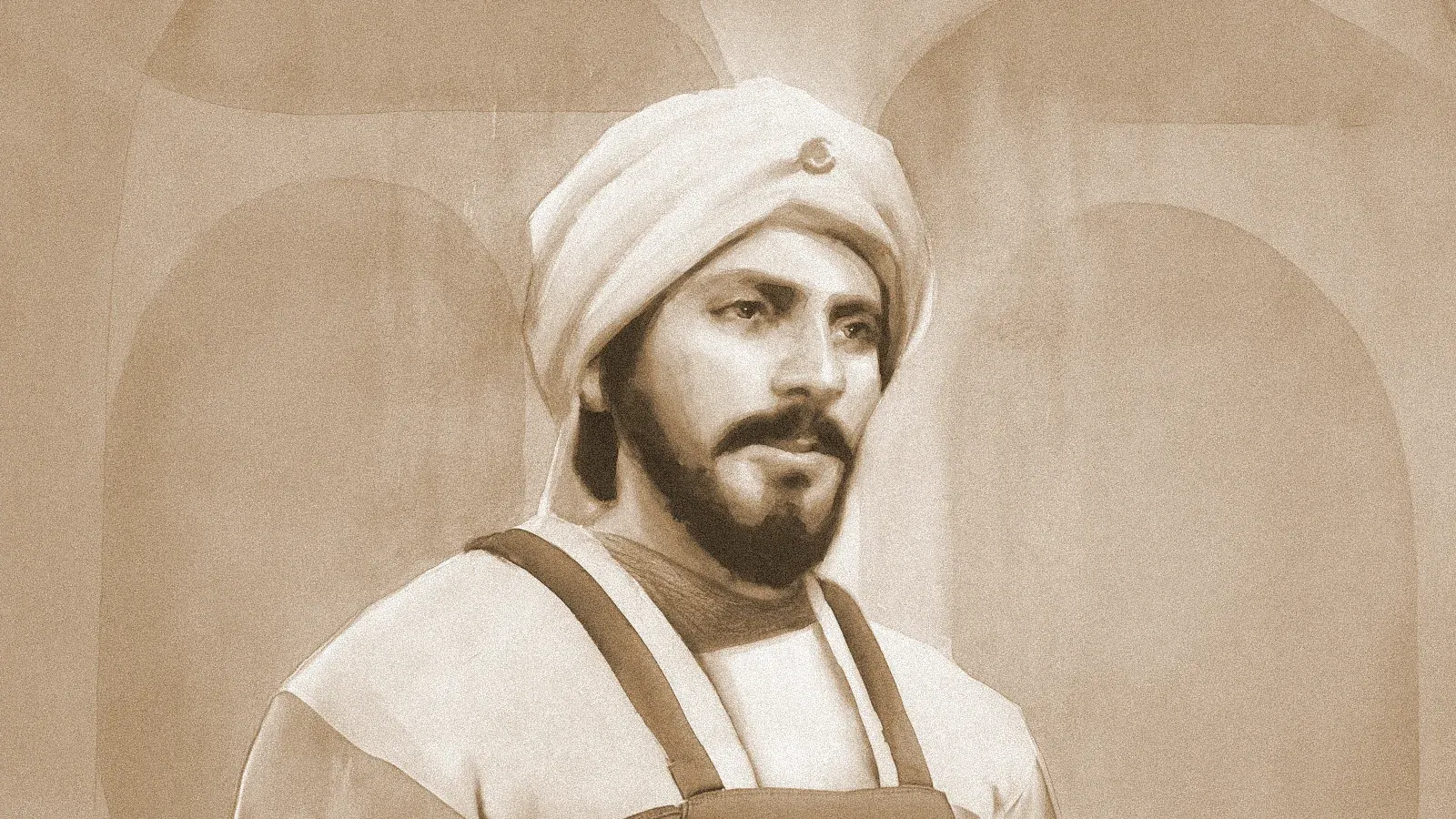
In brief — The periodontal scaler was not born in the 20th century. It was born in Córdoba, around the year 1000, in the hand of an Arab-Andalusian physician: Abu al-Qasim al-Zahrawi, known in the West as Albucasis. In his Kitab al-Tasrif he drew fourteen instruments for tartar removal and was the first to link calculus to periodontal disease. Gracey’s curettes, a thousand years later, are his children.
There is a gesture that periodontists and hygienists make thousands of times in the office, even though today several alternative instruments exist. The curette is laid against the root surface, you feel the roughness of the calculus, you smooth it down. It is a very old gesture.
In fact, that gesture is a thousand years old. And it has a name.
Córdoba, year 1000
His name was Abu al-Qasim Khalaf ibn al-Abbas al-Zahrawi. In Christian Europe they called him by the Latinized name of Albucasis. He was born around 936 in Madinat al-Zahra, the palatial city a few kilometres from Córdoba, capital of the Caliphate of al-Andalus. There, inside the largest library of medieval Europe — about four hundred thousand volumes — he became court physician to caliph al-Hakam II.
Córdoba, at the time, was the most populous city in Europe. It had paved streets, public lighting, hospitals, schools of medicine. While the rest of the continent treated illness with amulets, in al-Andalus they were dissecting cadavers and writing illustrated medical encyclopaedias.
Albucasis wrote one. Its title is Kitab al-Tasrif li-man ajiza an-il-ta’lif — The Arrangement of Medical Knowledge for One Who Cannot Compile a Manual for Himself. Thirty volumes. He spent fifty years writing it.
The last volume, the thirtieth, is dedicated to surgery. It is the first illustrated surgical treatise in the history of medicine.
The thirtieth volume
In that volume, among ligatures, lancets and cauteries, are entire plates dedicated to the teeth. Albucasis drew each instrument one by one. Fourteen different curettes and scalers, one for each surface: lingual, buccal, mesial, distal, supragingival and subgingival.
Fourteen. Striking.
It is the principle of the area-specific instrument: a dedicated geometry for each root surface. It is the principle that, a thousand years later, in 1941, Clyde H. Gracey would codify at the University of Michigan with his seventeen numbers. Same idea. Different instruments for different zones of the mouth.
Albucasis does not stop at inventing them. He writes how to use them. He writes that tartar must be removed above the gum, but also below. He writes that, if you cannot remove it all in one session, you must come back. As many times as needed. Until nothing remains. He writes that calculus is the cause of the disease that loosens the teeth — what centuries later would be called pyorrhoea and today we call periodontitis. Today we know it for certain; but he had imagined it before anyone else.
A thousand years ago. Without microbiology, without microscope, without Socransky. Pure observation.
The diagnosis that still holds
That paragraph of the Kitab al-Tasrif is, for the history of periodontology, what Pasteur is for the history of infections. Albucasis is the first to state explicitly the cause-effect link between calcified deposit and tooth loss.
For the first time in documented history, periodontal disease stops being a divine curse, an imbalance of humours, a punishment from the wrath of the Gods. It becomes a concrete thing that clings to the cervix of the tooth. And that can be removed to heal.
It can be removed with an instrument. The instrument can be designed. It can be designed specifically for every angle of the mouth. It can be refined.
All modern periodontology lives inside that intuition.
The protocol, word for word
In the thirtieth volume Albucasis does not just list. He dictates an operative sequence. It is worth reading it as if it were a contemporary clinical protocol, because that is what it is.
First: the patient seated, head supported, natural light from the window. Rinse of the mouth with warm water. Manual exploration of deposits, surface by surface.
Second: start from the visible surfaces, with the instrument best suited to the curvature of the crown. Work “until the tooth becomes a tooth again” — the expression is his. Check with the finger. If the surface is still rough, keep going.
Third: move under the gum. Here Albucasis is explicit. He writes that the disease will not heal unless you reach “the deposit that lies within the root”, and that to get there you need a thinner, more curved instrument. This is, in every respect, a description of closed subgingival scaling. Many modern colleagues and hygienists — those who seem to care only about the speed of the appointment, rather than its effectiveness — should reread this passage.
Fourth: if one session is not enough, come back. Albucasis recommends follow-up appointments. He already knows that calculus reforms, he already knows that oral hygiene is maintenance, not a one-off event. This, a thousand years before supportive periodontal therapy, is a radical idea — for that time and for ours. I can almost hear my hygienists. It is, decisively, all true.
Fifth: after scaling, rinses with astringent decoctions — oak gall, pomegranate, myrrh. Natural antimicrobials, the only chemistry available back then. The principle of mechanical-chemical plaque control, again, is not a 20th-century invention.
Replantation, ligation, atraumatic extraction
Albucasis does not stop at scaling. In the thirtieth volume he also describes replantation of avulsed teeth. He stabilizes mobile teeth with thin wires of gold or silver — a technique still recognizable in our composite splints. He draws ergonomic forceps for extraction and recommends not breaking the root, working slowly, respecting the alveolar bone. Well, well.
It is worth reading those recommendations side by side with our current ones. The distance is smaller than we like to think.
From Córdoba to Salerno, from Salerno to the world
In the 12th century Gerard of Cremona translates the surgical volume into Latin. The printer titles it Liber Alsaharavi de Cirurgia. From that moment the book enters the universities of Salerno, Bologna, Montpellier, Paris. For five hundred years it is the surgical textbook of reference of Christian Europe.
Guy de Chauliac, papal surgeon at Avignon in the 14th century, cites it more than two hundred times in his Chirurgia Magna. Pierre Fauchard, the père de l’odontologie moderne, knows it and quotes it in his Le Chirurgien Dentiste of 1728. The lineage is documented: Albucasis is the source.
From Albucasis to Gracey, in a straight line
Think of it next time you pick up a curette. That handle, that curved blade, that seventy-degree working angle — they are the product of a thousand years of refinement. But the original move belongs to a Cordoban physician of the tenth century who drew fourteen scrapers on a parchment.
Gracey added the ergonomic handle. Hu-Friedy added tempered stainless steel. Mini-five curettes halved the working area for deep pockets. All true. All useful. But the principle — a dedicated instrument for every surface, below the gum, repeated until nothing remains — that is from Albucasis.
In dentistry it happens often. You believe you are inventing and you are only rediscovering something that had already been seen. Brånemark with osseointegration, Misch with bone classification, Gracey with curettes: all of them walked on paths someone else had already traced. The same goes for Carl Koller and local anaesthesia, for Kazanjian and reconstructive surgery — the history of modern dentistry is, almost always, a history of rediscoveries.
To Albucasis we owe the scaler. But above all we owe him the first, lucid intuition: to cure periodontal disease, tartar has to come off. All of it. Above and below. Repeated, as many times as it takes.
A thousand years later, it is still the first gesture of therapy.
Bibliography
Asaad M, Rajesh A, Zazo A, Banuelos J, Kaadan A. Albucasis: A Pioneer Plastic Surgeon. Annals of Plastic Surgery, 2019; 83(6): 611-617. DOI: 10.1097/SAP.0000000000002023
Zarrintan S, Tubbs RS, Najjarian F, Aslanabadi S, Shahnaee A. Abu Al-Qasim Al-Zahrawi (936-1013 CE), Icon of Medieval Surgery. Annals of Vascular Surgery, 2020; 69: 437-440. DOI: 10.1016/j.avsg.2020.07.012
Ahmad Z. Al-Zahrawi — The Father of Surgery. ANZ Journal of Surgery, 2007; 77(Suppl 1): A83. PMC6077085
Hamarneh S. Drawings and Pharmacy in al-Zahrawi’s 10th-Century Surgical Treatise. United States National Museum Bulletin 228, Smithsonian Institution, 1961.
Lindhe J, Lang NP. Clinical Periodontology and Implant Dentistry, 7th ed. Wiley-Blackwell, 2022 — introductory chapter History of Periodontology.
FAQ
Who invented the periodontal curette and scaler?
What is the Kitab al-Tasrif?
Did Albucasis recognize tartar as a cause of periodontal disease?
What other dental innovations did he introduce?
What is the link between Albucasis and Gracey curettes?
References
Go deeper
Espansione crestale (split crest) →Allargare la cresta senza trapianto — tecnica ERE e bonebending
Need a professional opinion?
Book an appointment at Dr. Bruschi's practice in Frosinone. First visit includes full diagnosis and personalised treatment plan.
Stay Updated
New articles on periodontology, implantology and oral surgery — delivered to your inbox.
Comments
Loading comments...
Leave a comment